
Diagnostic Medical Ultrasound: The Complete Career Guide
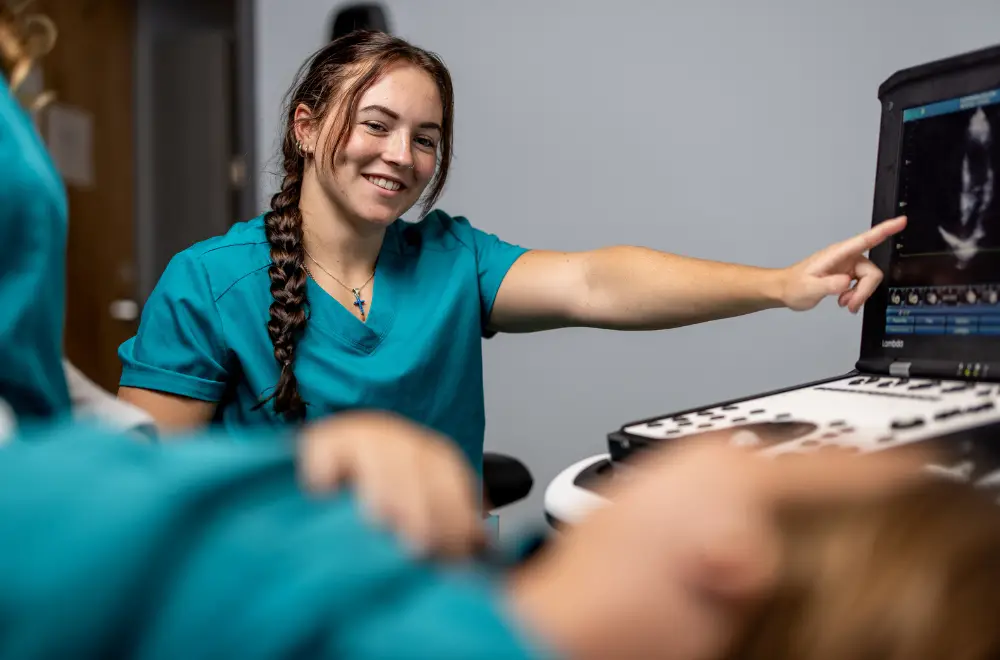
A diagnostic medical sonographer uses ultrasound equipment to create real-time images of organs, blood vessels, and tissue. Doctors use these images to diagnose and treat patients. Sonography is one of the fastest-growing careers in allied health, and it starts with an accredited associate degree, not a four-year commitment. Lackawanna College, a nonprofit college in Scranton, Pennsylvania, offers three CAAHEP-accredited ultrasound tracks at its Scranton campus. This guide covers the job, the education and certification path, how to pick a specialization, and what sonographers earn.
You may have already read about what a cardiac sonographer does day to day. This post fills in the bigger picture. It covers the whole field and all three specialization tracks. It also covers the accreditation and certification steps. These steps apply no matter which track you choose.
What Is a Diagnostic Medical Sonographer?
A diagnostic medical sonographer operates ultrasound equipment. This equipment captures images inside the human body without radiation. The images help physicians spot problems like blood clots, gallstones, tumors, or heart valve issues. They also support diagnoses in obstetrics, abdominal medicine, and vascular care.
On a typical shift, a sonographer reviews a patient’s history and the reason for the scan. Then the sonographer positions the patient and adjusts the equipment for a clear image. Then the sonographer records measurements and observations for the interpreting physician. The work is hands-on and patient-facing. It takes enough anatomy and physiology knowledge to catch a problem fast. An image can show something a radiologist or cardiologist needs to see right away. Sonographers work in hospitals, outpatient imaging centers, and physician offices, often with rotating shifts, evenings, or on-call time, since imaging needs don’t stop at 5 p.m.
The exact daily tasks shift depending on specialization. A cardiac sonographer spends most of the day scanning hearts and heart valves. A vascular sonographer focuses on blood flow and circulation. Want a closer look at one of those roles? See what a cardiac sonographer’s day looks like.
How to Become a Sonographer: Education, Accreditation, and Certification
Becoming a diagnostic medical sonographer takes three things. You need an accredited education, a passing exam score, and hands-on clinical hours. The U.S. Bureau of Labor Statistics lists an associate’s degree as the typical entry-level education for the field. Most employers expect it.
Accreditation comes from the Commission on Accreditation of Allied Health Education Programs, known as CAAHEP. CAAHEP accredits programs on the recommendation of the Joint Review Committee on Education in Diagnostic Medical Sonography (JRC-DMS). A CAAHEP-accredited program has been reviewed against national standards for curriculum, clinical training, and faculty. Attending a CAAHEP-accredited program also makes graduates eligible to sit for certification exams. A non-accredited program can close that door before a career even starts.
Certification comes from the American Registry for Diagnostic Medical Sonographers (ARDMS). ARDMS is the credentialing body most employers require. Getting certified means passing the Sonography Principles and Instrumentation (SPI) exam. It also takes at least one specialty exam. Options include Abdomen (AB), Obstetrics and Gynecology (OB/GYN), Adult Echocardiography (AE), and Vascular Technology (VT). Both exams must be passed within five years of each other.
Key Takeaway: Accreditation and certification are two separate steps that work together. CAAHEP accreditation qualifies a graduate to sit for an exam. ARDMS certification is the credential that gets a graduate hired. Skipping either one narrows job options a lot.
Choosing a Track: Diagnostic Medical, Cardiac, or Vascular Ultrasound
Not every sonography student picks the same path. Lackawanna College offers three specialization tracks at its Scranton campus. Each is a two-year associate degree with selective admissions. That means students apply separately to the program, on top of general college admission.
Diagnostic Medical Ultrasound is the broadest track. It covers abdominal and OB/GYN imaging. It’s a 70-credit program with a capped cohort. The pre-semester group caps at 25 students. The full program caps at 20. Graduates are prepared to sit for the ARDMS Abdomen and OB/GYN specialty exams. The 2024 cohort had a 92% job placement rate and an 87% retention rate. Details on prerequisites, courses, and outcomes are on the Diagnostic Medical Ultrasound program page.
Cardiac Ultrasound focuses on the heart and cardiovascular system. It’s a 73-credit program. The capped cohort is 25 students in the full two-year program. The program admits once a year, for a Fall start. The 2024 cohort had a 100% job placement rate. See the cardiac sonographer schooling page for the exact courses and clinical rotation structure. It also covers the admission timeline.
Vascular Ultrasound trains students to image blood flow and circulation. This is useful for spotting clots, blockages, and vein disease. It’s also a 70-credit, two-year program, with day, evening, and Saturday course options. The 2024 cohort reported a 100% job placement rate. Program specifics are on the Vascular Ultrasound program page.
Not sure which track fits? The general Ultrasound associate degree page compares all three side by side. An earlier post, breaking into the medical field with an ultrasound associate degree, covers the first year of any track.
Key Takeaway: All three Lackawanna sonography tracks are two-year, CAAHEP-accredited associate degrees with selective admissions. The difference is what part of the body a graduate ends up scanning, not how long school takes.
Sonographer Salary and Job Outlook
Pay and demand are two of the biggest reasons students look at sonography in the first place. BLS reports a Pennsylvania median of $82,710 for diagnostic medical sonographers as of May 2025. It covers all experience levels, specialties, and work settings statewide. Employment in the field is projected to grow 13% from 2024 to 2034. BLS classifies that as much faster than the average for all occupations.
That growth is driven by an aging population. Older adults need more imaging for heart disease, cancer screening, and vascular conditions. There’s also a shift toward ultrasound. Providers use it instead of pricier, more invasive imaging when ultrasound can do the job. An associate degree remains the standard entry point. The credential doesn’t require years of extra schooling to reach a strong starting wage.
Key Takeaway: A two-year associate degree is the typical entry point into this field. Pennsylvania sonographers earn a median of $82,710. Job growth runs well above the national average. That is a rare combination for a credential this length.
Sonography Training at Lackawanna College: What to Expect
All three sonography tracks at Lackawanna College run out of the Scranton main campus only. They do not run at any of the college’s other Northeastern Pennsylvania locations. The programs are selective. Admission involves a separate application to the sonography program, on top of general college admission. Applicants also need a prerequisite biology or anatomy and physiology course. It must be completed within the last three years. A college-level equivalent with a grade of C or better also meets this requirement.
Training combines classroom instruction, lab work, and clinical rotations in real imaging settings. Students practice hands-on before graduation instead of starting cold in a job. Clinical placements happen across a network of regional health systems. That gives students supervised scanning time with real patients before they sit for ARDMS exams. These rotations put students in patient-care settings. So accepted students must clear standard healthcare requirements first. That means CPR certification, background clearances, and a physical exam. It also means up-to-date immunization records, including the Hepatitis B series.
Not sure sonography is the right fit? Browse every healthcare option under the Medical Field career pathway.
Ultrasound Tech vs. Sonographer: Same Job, Different Name
“Ultrasound tech” and “sonographer” refer to the same job. Employers, job boards, and even BLS data use both terms. “Diagnostic medical sonographer” is the more formal, industry-standard version. “Ultrasound tech” is the more casual name. There’s no separate credential or shorter training path behind either title. The education, CAAHEP accreditation, and ARDMS certification requirements are the same either way.
The terms do split by specialty. “Cardiac sonographer” and “vascular sonographer” describe the specific area someone images. “Diagnostic medical sonographer” is sometimes used narrowly for the abdominal/OB-GYN track. It’s also used as an umbrella term for the whole profession. Job postings usually make the specialty clear, even when the title says “ultrasound technologist.”
Frequently Asked Questions
What is the difference between diagnostic medical sonography and ultrasound technology?
There isn’t a meaningful difference. They’re two names for the same profession. “Sonographer” and “ultrasound technologist” are used interchangeably by employers and in job postings. “Diagnostic medical sonographer” is the official title used by BLS and ARDMS.
How long does it take to become a diagnostic medical sonographer?
At Lackawanna College, all three ultrasound tracks are two-year associate degree programs. This includes Diagnostic Medical, Cardiac, and Vascular Ultrasound. That timeline includes classroom instruction, lab work, and clinical rotations. These are required for CAAHEP accreditation and to sit for ARDMS exams.
What is CAAHEP accreditation and why does it matter?
CAAHEP is the Commission on Accreditation of Allied Health Education Programs. It accredits sonography programs on the recommendation of the JRC-DMS. Graduating from a CAAHEP-accredited program is generally required to sit for ARDMS certification exams. Most employers require these exams for hire.
What is ARDMS certification?
ARDMS, the American Registry for Diagnostic Medical Sonographers, is the credentialing body for the field. Certification requires passing the SPI (Sonography Principles and Instrumentation) exam. It also requires at least one specialty exam. Options include Abdomen, OB/GYN, Adult Echocardiography, and Vascular Technology. Both exams must be passed within five years of each other.
What sonography specializations does Lackawanna College offer?
Lackawanna College offers three CAAHEP-accredited, two-year associate degree tracks at its Scranton campus. These are Diagnostic Medical Ultrasound (abdominal and OB/GYN), Cardiac Ultrasound, and Vascular Ultrasound.
Is admission to Lackawanna’s sonography programs selective?
Yes. Unlike most of Lackawanna’s open-enrollment programs, sonography admission is selective. Each track has its own cohort cap and application, on top of general college admission. Each track also has prerequisite science coursework.
What is the job placement rate for Lackawanna’s sonography programs?
For the 2024 cohort, Lackawanna’s Cardiac Ultrasound and Vascular Ultrasound programs each reported 100% job placement. The Diagnostic Medical Ultrasound program reported 92% job placement and an 87% retention rate. Any placement statistics below 100% are attributable to students who declined a job offer or elected to continue their education in an alternative modality before entering the workforce. These figures reflect the Scranton campus programs specifically and are not a guarantee of employment for future graduates.
What do diagnostic medical sonographers earn?
BLS reports a Pennsylvania median of $82,710 for diagnostic medical sonographers as of May 2025. That covers all experience levels across the state. The occupation is projected to grow 13% from 2024 to 2034. That’s much faster than the average for all occupations.
Taking the Next Step
Sonography is a two-year path into a healthcare career. It offers strong pay and above-average job growth. The admissions process is selective, so it helps to start early. Ready to see whether Diagnostic Medical, Cardiac, or Vascular Ultrasound fits your goals? You can request information from Lackawanna College. You can also talk to an enrollment counselor. Ask about prerequisites and cohort timing before you apply. Still comparing healthcare programs? The Medical Field career pathway lists every option Lackawanna offers.
Educational Disclaimer
Lackawanna College’s sonography programs are accredited by the Commission on Accreditation of Allied Health Education Programs (CAAHEP). CAAHEP’s address is 9355 113th St. N, #7709, Seminole, FL 33775. This accreditation is upon the recommendation of the Joint Review Committee on Education in Diagnostic Medical Sonography (JRC-DMS). Job placement and retention figures cited above are self-reported outcomes for the Scranton campus programs’ 2024 cohorts. These figures do not guarantee admission, graduation, certification, or employment for any individual student. Wage figures are Pennsylvania statewide medians from the U.S. Bureau of Labor Statistics Occupational Employment and Wage Statistics survey (May 2025 release) and cover all experience levels. Job growth projections are national figures from the BLS Occupational Outlook Handbook (2024–34). Neither is a guarantee of individual earnings. Lackawanna College does not discriminate on the basis of race, color, national origin, sex, disability, or age in its programs and activities.